




Type something to search...
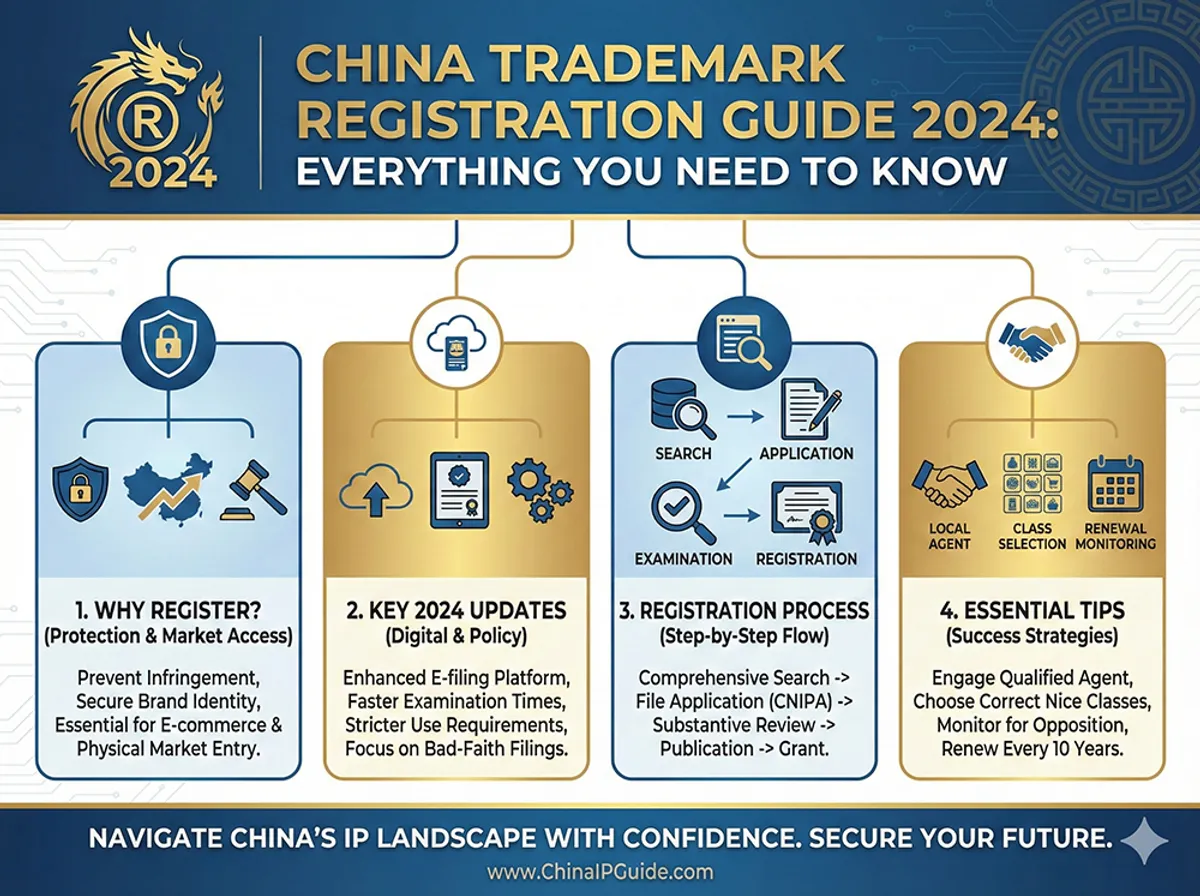
China Trademark Registration Guide 2024: Everything You Need to Know

China Trademark Registration Guide 2024: Everything You Need to Know

Understanding China’s trademark system is crucial for any international brand entering the Chinese market. This comprehensive guide covers everything you need to know about trademark registration in China in 2024.

Why Trademark Protection Matters in China

China operates on a “first-to-file” system, meaning whoever files first owns the trademark rights—regardless of who used it first internationally. This has led to numerous cases of trademark squatting, where local entities register famous foreign brands before the actual brand owner does.

Notable Examples

  • New Balance lost their Chinese trademark and had to pay $16 million
  • Michael Jordan fought a 7-year legal battle over his Chinese name
  • Tesla’s trademark was initially registered by a Chinese businessman

The Chinese Trademark Registration Process

Step 1: Comprehensive Search (2-3 weeks)

Before filing, conduct thorough searches across:

  • Exact matches in all 45 Nice Classification classes
  • Phonetic similarities in Chinese
  • Visual similarities in logos
  • Translation variations

Pro Tip: Chinese consumers often create their own translations of foreign brand names. Search for these “folk translations” to avoid conflicts.

Step 2: Chinese Name Selection

Choosing the right Chinese name is critical. Consider:

  • Phonetic similarity to your original name
  • Positive meaning in Chinese
  • Cultural appropriateness
  • Memorability for Chinese consumers

“The China IP Gateway team helped us build a full defensive trademark strategy. The dashboard showed real-time updates.” - Kenji Tanaka, Luminex Japan

Step 3: Multi-Class Filing Strategy

Most brands need protection in multiple classes:

  • Core classes: Your actual products/services
  • Defensive classes: Adjacent categories where infringement is likely
  • E-commerce classes: Class 35 for online retail is essential

Step 4: Application Filing (1-2 weeks)

Required documents:

  • Application forms for each class
  • Clear trademark specimens
  • Applicant identification documents
  • Power of Attorney

Step 5: Examination (9-12 months)

CNIPA (China National Intellectual Property Administration) reviews your application for:

  • Absolute grounds (descriptiveness, prohibited marks)
  • Relative grounds (conflicts with existing marks)

Step 6: Publication & Registration (3 months)

If approved, your trademark is published for opposition. If no opposition is filed within 3 months, you receive your registration certificate.

Total Timeline: 12-15 months

Pricing Structure

Basic Registration: USD 600-900 per class

  • Includes search, filing, and official fees
  • Monitoring during examination
  • Certificate delivery

Comprehensive Protection Package: Custom pricing

  • Multi-class registration
  • Defensive filing strategy
  • Chinese name consultation
  • Ongoing monitoring

Common Challenges & Solutions

Challenge 1: Similar Existing Marks

Solution: File in specific subclasses or modify your mark slightly while maintaining brand identity.

Challenge 2: Descriptive Terms

Solution: Add distinctive elements or create a coined term that’s unique to China.

Challenge 3: Translation Issues

Solution: Work with native Chinese trademark experts who understand both linguistic and cultural nuances.

Best Practices for International Brands

  1. File Early: Before entering the market or making announcements
  2. File Broadly: Cover all relevant classes from the start
  3. Monitor Actively: Set up trademark watching services
  4. Enforce Consistently: Take action against infringers quickly
  5. Use Professional Help: The cost of mistakes far exceeds professional fees

Post-Registration Maintenance

  • Renewal: Every 10 years
  • Use Requirements: Use within 3 years to avoid cancellation
  • Record keeping: Maintain evidence of use
  • Customs recordation: Register with Chinese customs for border enforcement

Conclusion

Trademark protection in China requires proactive planning and expert guidance. With the right strategy, you can secure strong protection for your brand in the world’s largest consumer market.

Ready to protect your brand in China? Contact our trademark experts for a free consultation.

Related Posts

Insights
blog-thumb
By Peter Lin/ On 01 Dec, 2025

How to Protect Your Idea Quickly in China: A Personal Note from the Train

🇨🇳 Why Dual Filing Works in China A utility‑model patent covers structural or mechanical improvements and typically grants within about six months. Think of it as a quick shield. It gives you an enforceable right early, so you can show investors, partners and even Customs officials that your design is protected. Meanwhile, you simultaneously file a full invention patent, which takes longer but provides stronger, broader protection once it is granted. By starting them both together, you protect yourself at two speeds: fast and long‑term. Once the invention patent is issued, you can withdraw the utility model to avoid double. 🔍 Does it suit every innovation? This strategy shines for hardware or structural improvements—think product casings, mechanical components, new configurations or machinery. For software, algorithms or purely digital inventions, you still need to go through the standard invention patent route (which takes time), and other IP tools like copyright or trade secrets may be more appropriate. 🚀 My advice to fellow founders Don’t wait for perfection. File early, iterate quickly. In China’s “first to file” system, speed matters. Leverage the fast and slow lanes. A utility model buys you time; the invention patent keeps your protection strong for the long run. Tell your story. Investors and partners respond better when you can show that you’ve taken proactive steps to secure your IP, rather than saying “we’re working on it.” As someone who’s helped many startups navigate this path, I know first‑hand how disheartening it is to see a good idea copied simply because the filing happened too late. Don’t let that be your story. If your products touch China, your protection strategy should too. Feel free to reach out if you’d like help planning your IP filings or understanding which options best fit your product. Safe travels and safe ideas!

China IP Guides
blog-thumb
By Peter Lin/ On 20 Mar, 2026

PCT Translation Errors in China: What Foreign Applicants Can Correct, and When

Most foreign applicants submit a PCT translation into Chinese and move on. The translation is outsourced, filed under deadline pressure, and rarely reviewed against the original international application text. In many cases it is fine. But in a meaningful number of cases it is not — and when a translation error in China patent prosecution affects claim scope, the consequences can be permanent. This guide explains what correction is actually available, when it must happen, what makes a change qualify as a genuine translation correction versus an amendment, and how the situation differs depending on how you filed in China in the first place. Why This Issue Matters More Than Most Foreign Applicants Expect Translation in patent work is not a purely linguistic task. It makes legal commitments. A Chinese translation of a PCT application becomes the operative text for prosecution in China — and eventually for enforcement. If the translation unduly narrowed a claim because a technical term was rendered too specifically, or if a feature was added that was not in the original, the Chinese patent that results will not accurately reflect what the applicant actually invented. The commercial stakes are real. An overly narrow claim in China may fail to catch a competitor whose product would clearly have fallen within the scope of the original English claims. A translation that introduced a feature not in the original could expose the patent to an invalidity challenge after grant. Neither outcome is easy to manage, and neither is cheap to fix if it is fixable at all. What foreign applicants often miss is that unlike some jurisdictions where post-grant correction is relatively accessible, China's system is comparatively unforgiving once a patent is granted. The windows to act exist — but they close, and they do not reopen. First, Separate Two Very Different Situations: PCT Entry vs Paris Filing The most important distinction to establish before anything else is this: how did you file in China? If you filed an international application under the PCT and later entered China national phase using a Chinese translation of that international application, you are in a different legal situation from someone who filed a Paris Convention direct application in Chinese from the start. For PCT national phase entries, Chinese law recognises that the Chinese translation is not the original — the international application filed with the receiving office is. This creates space for a translation correction mechanism, because there is a defined reference text against which the Chinese translation can be checked. The rules governing PCT entry into China — filing timelines, language requirements, and the translation submission process — are described in more detail in the guide on 12 vs. 30 months and the critical windows for China patent protection. For Paris Convention direct filings in Chinese, the Chinese text you filed is the original. There is no foreign-language source to correct against. General amendment rules apply, and translation correction as a concept does not exist. These two routes operate under different rules and require different approaches to error management. Conflating them is one of the more consequential mistakes in managing a China patent portfolio. What China Usually Allows for PCT Translation Corrections China's Patent Law Implementing Regulations provide that where an international application was filed in a foreign language and the Chinese translation deviates from the original international application, the applicant may request that CNIPA amend the Chinese text to conform to the original. The governing standard in practice: the correction must be based on the text of the original international application as filed at the PCT receiving office — the International Bureau's record of the application as it existed on the international filing date. Later amendments made during the international phase, whether through Article 19 (claims amendments) or Article 34 (examination amendments), are not automatically the baseline unless those amended texts were formally designated for entry into China. The purpose of this mechanism is narrow. It is designed to restore accuracy — to bring the Chinese text into alignment with what the original actually said. It is not a vehicle for improving claim coverage, responding to prior art identified during prosecution, or adding technical content that was not in the original disclosure. The Two Time Windows That Matter In practice, there are two main moments when a translation correction in China is realistically pursued. Window one: voluntary correction before CNIPA raises a concern. A translation correction request can be filed at any point before the patent is granted. In practice, the earlier the better — ideally before or at the start of substantive examination, before the examiner has relied on the translated text to form any view on the claims or the disclosure. Some applicants with significant China patent programs now conduct a brief translation review of claim language shortly after national phase entry, specifically to catch material errors at this early stage. The cost of doing so is a fraction of the cost of managing the consequences later. Window two: in response to an Office Action. CNIPA examiners do occasionally identify apparent inconsistencies between the Chinese claim language and what the description suggests the invention actually is. Where the underlying reason is a translation error, this is often the first moment a foreign applicant becomes aware of the problem. The response period to the Office Action then becomes the operative correction window. Missing it, or filing a response that does not properly address the translation issue, can produce a permanent narrowing. What there is not, in most cases, is a meaningful correction window after the patent has been granted. Post-grant correction in China is procedurally difficult and not generally available as a practical remedy for scope problems that trace to translation errors. What Usually Counts as a Real Translation Error Not every disappointing outcome in a Chinese patent claim reflects a translation error. The concept has a defined meaning. Translation errors that typically qualify for correction include: Linguistic divergence from the original — where a technical term was rendered using a Chinese expression that carries a different scope or meaning from the original, and the correct translation is objectively clear when the two texts are read side by side. Structural inversions — where a sentence in the original describes a limitation as optional but the Chinese translation rendered it as mandatory, or vice versa, in a way that clearly misrepresents the original syntax. Omissions — where a phrase or clause clearly present in the original was dropped from the Chinese translation, and the omission is visible without any interpretive judgment. The unifying principle is objective: the Chinese text should have said something specific, it did not because of a translation failure, and the original supports the proposed correction without needing to read anything into it. What Usually Does Not Qualify The limits of translation correction are regularly tested, usually by applicants who want to recover claim scope for reasons that are not about translation fidelity. Adding a technical feature not present in the original international application does not qualify, even if the inventor believes it would strengthen the claims or better describe the actual product. This is new matter, not linguistic restoration. Expanding claim scope in a direction the original text does not straightforwardly support similarly falls outside the mechanism. CNIPA will assess whether the proposed correction reflects what the original actually said. If the correction requires reading the original in a way that is not objectively supported by its text, it will be treated as an amendment rather than a correction — and assessed under more restrictive rules. Using "translation correction" to clean up informal or imprecise expression in the original description is also not available. The mechanism corrects the Chinese rendering of a text; it does not improve the underlying text itself. The practical test is reasonably direct: would a competent translator, working carefully from the original, have produced the corrected Chinese text? If the answer requires a fresh technical or legal judgment rather than a straightforward linguistic reversal, the proposed change is unlikely to be accepted as a mere translation correction. Translation Correction vs Ordinary Amendment These are two distinct mechanisms, and the distinction has substantive consequences. A translation correction, when accepted, is treated as restoring what the original text actually said. The corrected Chinese text is read as having been the correct translation from the outset — it changes the operative text of the application back to what it should have been. An ordinary amendment under China Patent Law is subject to a different and more limiting standard: it cannot introduce content that goes beyond the scope of what was disclosed in the original application. Crucially, for PCT cases, the baseline for amendment purposes is the Chinese translation as originally submitted — not the original foreign-language international application. If your Chinese translation is narrower than the original, you generally cannot use an ordinary amendment to recover the broader scope, because the narrower Chinese translation is what CNIPA treats as defining the disclosure for amendment purposes. This asymmetry is what makes the translation correction mechanism so important: if a material narrowing error is not caught and corrected within the translation correction framework, ordinary amendment may not be sufficient to fix it at all. The scope is simply gone. For a related discussion of how amendment rules work in PCT cases more broadly, the guide on how much you can amend claims when entering China via PCT covers the "no new matter" rules and common mistakes in detail. What About Paris Convention Direct Filings? For a Paris Convention direct filing in Chinese, the Chinese text filed is the original application. There is no foreign-language reference document from which a translation correction can be requested. The general amendment rules under China Patent Law apply. Voluntary amendments can be made within a defined early window after filing. Amendments in response to Office Actions are permitted within the prescribed response periods. In both cases, the governing constraint is the same: amendments cannot introduce technical content beyond the scope of the original disclosure. Since the Chinese text is the original, the question of what "the original said" and what the translation "should have said" simply does not arise. In practice, Paris Convention direct filings into China are typically prepared in Chinese from the start by a China-registered patent attorney, and the national-phase translation problem does not apply in the same form. The risks are of a different character — incomplete disclosure, claim language that does not match the description, terminology inconsistencies — and they are addressed through the general amendment process rather than any translation-specific mechanism. What Happens If You Do Nothing? If a translation error is identified but not acted on, the consequences depend on the nature of the error and where the application is in its lifecycle. An error that narrowed the claims and was never corrected may result in a patent that grants with claims too narrow to be useful — and with no mechanism to recover the original scope after grant. The commercial asset the applicant expected to hold in China may be materially weaker than anticipated. An error that introduced content not in the original, if identified by CNIPA during examination, will produce an objection that the claims or description lack support in the original. If the error is identified only after grant, by a third party seeking to challenge the patent, it can form the basis of a well-founded invalidation action. An error that distorts the meaning of a technical feature creates prosecution history risks: CNIPA's examination record reflects the Chinese text, including the error, and this record is relevant to later infringement analysis. A patentee relying on a Chinese claim that diverges from the original may face difficult questions about scope and intent. The real risk of inaction is not always visible during prosecution. Applications often grant without the translation error being raised. The consequences surface when the patent is needed — in enforcement, licensing, or a dispute — and by then the correction window is long closed. A Simple Internal Review Method for Foreign Applicants Foreign applicants managing a China patent portfolio with PCT entries can reduce translation-related risk with a straightforward internal review practice. After receiving confirmation of national phase entry and the Chinese filing documents, request a reverse translation of the claims: a translation from the Chinese claims back into English, done by someone who has not seen the original English claims. Then compare this reverse translation against the original international application claims side by side. Differences in scope, omitted elements, and structural inversions typically become visible in this exercise without requiring deep technical expertise. The review is not looking for every nuance — it is looking for material divergences that could affect what the patent actually covers. Where a material divergence is identified, consult with a China patent attorney on whether the issue qualifies for a translation correction, an ordinary amendment, or requires a different strategy. The earlier this consultation happens after national phase entry, the more options are available. This practice is not a substitute for a full professional review of the description and drawings — but for claim scope, which is where translation errors most often cause commercial harm, it is a practical and low-cost step that a significant number of applicants currently skip. For those still evaluating whether and when to enter China via PCT — including the timing decisions that affect which correction tools are even available — the PCT national phase slimming strategy guide covers the strategic framework for that earlier decision. Final Takeaway Translation errors in China patent applications are not rare, and they are not always visible during prosecution. For PCT national phase entries, Chinese law offers a correction mechanism — but it is bounded. It requires a genuine translation error. It requires the proposed correction to be grounded in the original international application text. And it has time windows that close before grant and do not reopen. What foreign applicants need most is not a comprehensive map of every procedural rule, but a practical habit: review the Chinese translation of your claims after national phase entry, before substantive examination begins. If something looks materially wrong against the original, act early. The cost of a translation correction request at that stage is a fraction of what it costs to manage a scope problem after grant — or to lose the scope entirely. If you are working through a China patent filing and have questions about translation review, national phase entry strategy, or claim scope, the China Patent Filing and China Patent Attorney pages describe how we work with foreign applicants on these questions directly.

Patent Protection
blog-thumb
By Peter Lin/ On 15 Oct, 2024

5 Critical Mistakes to Avoid When Filing Patents in China

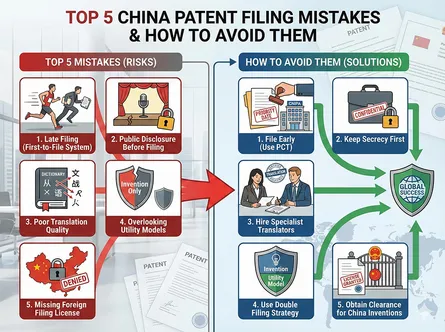
When filing patents in China, many international companies make costly mistakes that could have been easily avoided. Based on our decade of experience handling 3,000+ IP cases, here are the five most critical errors and how to prevent them. 1. Waiting Too Long to File China operates on a strict "first-to-file" system. Unlike the US grace period, any public disclosure before filing can invalidate your patent application. We've seen companies lose patent rights simply because they presented at a conference before filing. Solution: File your Chinese patent application before any public disclosure, trade show, or academic publication. Consider filing provisionally to secure your priority date. 2. Using Direct Translation Without Technical Review Patent terminology requires precision. Direct translations often miss technical nuances or use incorrect Chinese technical terms, leading to weak patent claims or office action rejections. Solution: Work with IP professionals who combine technical expertise with translation skills. Our team includes Ph.D.-level experts who understand both the technology and Chinese patent terminology."Their backend QA system caught an error in our drawings that even our internal team missed. That's real expertise." - Dr. Andreas Müller, BioPhoton GmbH3. Ignoring the Patent Prosecution Highway (PPH) Many companies don't realize they can accelerate Chinese patent examination from 18-24 months down to 6-8 months using PPH, if they have corresponding patents in other jurisdictions. Solution: If you have granted or allowed patents in the US, Europe, Japan, or Korea, leverage PPH to fast-track your Chinese applications. This can save significant time and costs. 4. Filing Too Broad or Too Narrow Some companies file overly broad claims that get rejected, while others file too narrowly and miss protection opportunities. Both approaches waste time and money. Solution: Conduct thorough prior art analysis specific to China's patent database. Our strategic approach balances strong protection with realistic grant expectations. 5. Neglecting Portfolio Management Filing a patent is just the beginning. Without proper maintenance, renewal tracking, and strategic portfolio review, companies lose protection inadvertently or waste money on unnecessary patents. Solution: Use a systemized platform for tracking deadlines, renewals, and portfolio strategy. Our dashboard provides real-time visibility into your entire China IP portfolio. Key TakeawaysFile before any public disclosure Use technical experts for translations Leverage PPH when possible Balance claim scope strategically Implement systematic portfolio managementReady to protect your innovations in China the right way? Book a consultation with our patent experts today.

Insights
blog-thumb
By Peter Lin/ On 26 Nov, 2025

Why IP之道 Isn't Just a Book — It's a Blueprint for Your Brand's China Entry

📘 From Theory to Blueprint When I co-wrote IP之道, my goal wasn’t to produce another academic book on patents or trademarks. It was to explain how businesses — from startups to global brands — can build real value through IP. The book explores three essential ideas: IP as Strategy, not as Shield — Treat IP as part of your business design, not just a legal backup. From Filing to Operation — Owning rights is easy; using them to drive growth is the real skill. Cross-Border Mindset — In a globalized supply chain, your rights must move with your products. At the time, many Chinese companies were learning how to expand overseas. But in recent years, I’ve noticed the opposite need emerging — foreign companies now face serious IP challenges when manufacturing in China. Article content This realization led directly to the creation of China IP Gateway. 🌏 When Global Meets Local — The Birth of China IP Gateway In the past decade, I’ve helped hundreds of international clients protect their ideas and brands in China. Again and again, I saw the same pattern repeat itself: A European electronics brand loses its trademark to a former factory partner. A US startup’s product drawings are used for a “utility model” patent by its supplier. A global brand delays its registration, only to be blocked by Customs when exporting from Shenzhen. The problems were never just legal — they were structural. Foreign brands often had great IP portfolios abroad but no defense layer inside China. Article content That’s why I founded China IP Gateway — a platform designed to turn the principles of IP之道 into real-world protection. We connect foreign innovators with China’s IP system through: Trademark registration and defense strategies Patent filing and enforcement coordination Customs IP recordal and monitoring Integrated backend tracking system powered by OpenPTO In short, China IP Gateway is where global vision meets Chinese execution. 💡 Lessons from “IP之道” in Today’s Context Writing IP之道 taught me one powerful truth: “You can’t manage what you can’t see.” Most companies fail not because they don’t care about IP, but because they don’t map it. They treat IP as a document, not as an ecosystem. At China IP Gateway, we’ve built tools to visualize that ecosystem — to let clients see their filings, timelines, and risks in one centralized dashboard. This isn’t just about convenience; it’s about clarity. When you see how your IP connects with your supply chain, your decisions become faster, safer, and smarter. 🚀 Why It Matters Now In today’s geopolitical and commercial landscape, the gap between manufacturing in China and owning in China is widening. Factories can produce faster than ever, but legal systems move on paperwork — not promises. So if your products touch China, your brand protection must too. Otherwise, you risk being the innovator who became an imitator — not because you lacked creativity, but because you lacked registration. That’s the ultimate lesson of IP之道 — and the mission of China IP Gateway. ✳️ Final Thought When I wrote IP之道, I believed that understanding IP would help companies survive the age of innovation. But after years of working on both sides of the global supply chain, I’ve learned something deeper: IP is not just about survival — it’s about sovereignty. Your designs, your brand, your story — they deserve protection in the place where they are born, built, or shipped. That’s why we created China IP Gateway — to turn that philosophy into a system. A system where international founders can protect, monitor, and grow their intellectual assets — all from one trusted platform. If your products touch China, your IP strategy should too. Visit chinaipgateway.com to see how your brand can move from theory to defense. China IP Gateway, Peter Lin, IP之道, Intellectual Property China, Trademark Registration China, Patent Filing China, Brand Protection, OEM Risk, China Manufacturing, IP Strategy originally published in my Linkedin : https://www.linkedin.com/pulse/why-ip%E4%B9%8B%E9%81%93-isnt-just-book-its-blueprint-your-brands-china-peter-lin-usbsf/?trackingId=7czh0mfoSXS1xIHih2me1A%3D%3D