





Type something to search...

Brand protection

Practical Answers
blog-thumb
By Peter Lin/ On 19 Mar, 2026

Do I Need a China Trademark Before I Talk to a Manufacturer?

A surprising number of foreign brands begin talking to suppliers, packaging vendors, sourcing agents, or manufacturers in China before they have taken even a basic China trademark step. That usually feels efficient at first. The team wants to move. Samples need to be discussed. Packaging language needs to be tested. Product names start appearing in decks, emails, mockups, and quotations. Everyone tells themselves the trademark can be handled “once things get more serious.” In many cases, that is exactly backwards. The Real Question The question is not whether you need a China trademark eventually. If China matters commercially, that answer is usually yes. The real question is: Do you need at least some China trademark thinking before your brand begins circulating through manufacturing, sourcing, packaging, or go-to-market conversations? For many foreign brands, the answer is also yes. That does not mean every business must file immediately in all classes before any contact with China. But it does mean that brand exposure often starts earlier than founders expect — and earlier than many teams budget for. Why This Issue Starts Earlier Than People Think Many foreign clients assume trademark risk begins when they officially launch in China. In practice, it can begin much earlier:when the product name appears in supplier emails; when packaging artwork is shared for quotation; when a logo file is circulated for printing or molding; when a distributor or factory sees the English mark and starts asking whether there is a Chinese name; when the team uses the brand publicly in trade channels connected to China.At that point, your brand is no longer living only inside your own internal business. It has entered a wider commercial environment. What Foreign Brands Often Miss The most common mistake is treating manufacturing and trademark protection as separate phases. A brand owner may think: “We are not launching yet. We are only sourcing.” But if your supplier relationships, packaging references, product labels, mockup files, or Chinese market plans are already tied to a specific brand identity, then the trademark question has already started. And once a brand becomes commercially visible in China-facing conversations, waiting may stop being a neutral choice. What Usually Matters First Not every case needs the same first move. Here is a practical way to think about it. If you already have a final English brand name Do not assume that is enough. Ask whether the English mark itself should be reviewed for China filing, and whether a Chinese name strategy should begin now rather than later. If you are sharing packaging or product branding with suppliers You are already beyond pure “internal planning.” At minimum, you should assess filing timing and subclass coverage before broader exposure grows. If you do not yet know your final China-facing brand structure That is exactly why a review is useful. It is often better to clarify the route before a name begins spreading informally. If you are in a hurry That is not unusual. But speed is a reason to make the right first move, not a reason to skip it. Why Supplier Conversations Can Increase Brand Risk A supplier relationship is not automatically a trademark problem. But it can become one quickly because suppliers often sit close to other parts of the market:packaging vendors; other factories; distributors; sourcing intermediaries; logistics and customs-facing service providers.The more your branding circulates, the less control you have over where and how it is seen. That is why contract protection alone is not enough. A supplier-stage document may help reduce disclosure and misuse risk, but it does not replace registration strategy. If your issue is on the contract side, review China NNN & OEM Agreements. If your issue is on the brand side, the right next page is China Trademark. Why China Trademark Work Is Not Just “File One Mark, One Class” Another mistake foreign brands make is thinking this issue is simply about getting one certificate. In real work, early China trademark decisions often involve:whether the English mark should be filed as-is; whether a Chinese name should be created now; how subclass logic affects practical coverage; whether the current manufacturing stage justifies broader or narrower action; whether filing should be coordinated with product launch timing and supplier exposure.That is why a practical first review is often more valuable than rushing blindly into a filing that feels cheap but solves the wrong problem. How This Connects to Patents and Contracts For many physical-product businesses, the brand question is not isolated. Contract layer If you are about to disclose product details to a Chinese factory, you may also need contract-side protection, especially around non-use, non-disclosure, and non-circumvention. That is a different layer from trademark registration, but the timing often overlaps. Patent layer If the protectable value is also in product structure or function, the patent timing question may need to be addressed before deeper supplier disclosure. In that case, China Patent Filing Support becomes relevant too. The practical point is simple: If China supplier conversations are starting, your brand, product, and contract exposure may all be starting together. What a Good First Step Looks Like A good first step is usually not “file everything immediately” or “do nothing until launch.” It is usually a structured first review that asks:What brand is actually in use? Is there a likely Chinese name issue? What classes and subclasses matter commercially? Has supplier-stage exposure already begun? Do contract and patent timing need to be reviewed at the same time?That is why a staged trademark entry path is often the most practical option. You can review the route through China Trademark or, if you are deciding among packaged starting points, check Pricing. Frequently Asked Questions What if I am only talking to one factory and trust them? Trust is valuable, but trust is not a substitute for structure. A factory conversation can still create wider exposure than founders expect, especially when branding appears in packaging, samples, sourcing discussions, or related vendor interactions. Do I need a filed China trademark before every supplier conversation? Not always. But you do need to know whether the conversation you are about to have is likely to create enough brand exposure that filing should no longer be postponed casually. What if I have not decided on a Chinese brand name yet? That is common. The right response is not to ignore the issue, but to decide whether Chinese naming should be part of the early brand plan. Final Thought A China trademark is not just a “market entry formality.” In many cases, it is part of the preparation work that should happen before manufacturing-side exposure expands. If your brand is about to enter supplier, packaging, or sourcing conversations tied to China, the most practical move is to review the route before the brand spreads faster than the protection around it. Start with China Trademark or Talk to Us if you want a practical first-step view.

Insights
blog-thumb
By Peter Lin/ On 01 Dec, 2025

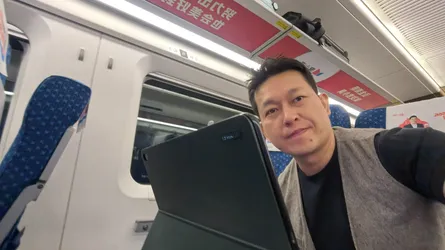
How to Protect Your Idea Quickly in China: A Personal Note from the Train

🇨🇳 Why Dual Filing Works in China A utility‑model patent covers structural or mechanical improvements and typically grants within about six months. Think of it as a quick shield. It gives you an enforceable right early, so you can show investors, partners and even Customs officials that your design is protected. Meanwhile, you simultaneously file a full invention patent, which takes longer but provides stronger, broader protection once it is granted. By starting them both together, you protect yourself at two speeds: fast and long‑term. Once the invention patent is issued, you can withdraw the utility model to avoid double. 🔍 Does it suit every innovation? This strategy shines for hardware or structural improvements—think product casings, mechanical components, new configurations or machinery. For software, algorithms or purely digital inventions, you still need to go through the standard invention patent route (which takes time), and other IP tools like copyright or trade secrets may be more appropriate. 🚀 My advice to fellow founders Don’t wait for perfection. File early, iterate quickly. In China’s “first to file” system, speed matters. Leverage the fast and slow lanes. A utility model buys you time; the invention patent keeps your protection strong for the long run. Tell your story. Investors and partners respond better when you can show that you’ve taken proactive steps to secure your IP, rather than saying “we’re working on it.” As someone who’s helped many startups navigate this path, I know first‑hand how disheartening it is to see a good idea copied simply because the filing happened too late. Don’t let that be your story. If your products touch China, your protection strategy should too. Feel free to reach out if you’d like help planning your IP filings or understanding which options best fit your product. Safe travels and safe ideas!

Insights
blog-thumb
By Peter Lin/ On 26 Nov, 2025

Why IP之道 Isn't Just a Book — It's a Blueprint for Your Brand's China Entry

📘 From Theory to Blueprint When I co-wrote IP之道, my goal wasn’t to produce another academic book on patents or trademarks. It was to explain how businesses — from startups to global brands — can build real value through IP. The book explores three essential ideas: IP as Strategy, not as Shield — Treat IP as part of your business design, not just a legal backup. From Filing to Operation — Owning rights is easy; using them to drive growth is the real skill. Cross-Border Mindset — In a globalized supply chain, your rights must move with your products. At the time, many Chinese companies were learning how to expand overseas. But in recent years, I’ve noticed the opposite need emerging — foreign companies now face serious IP challenges when manufacturing in China. Article content This realization led directly to the creation of China IP Gateway. 🌏 When Global Meets Local — The Birth of China IP Gateway In the past decade, I’ve helped hundreds of international clients protect their ideas and brands in China. Again and again, I saw the same pattern repeat itself: A European electronics brand loses its trademark to a former factory partner. A US startup’s product drawings are used for a “utility model” patent by its supplier. A global brand delays its registration, only to be blocked by Customs when exporting from Shenzhen. The problems were never just legal — they were structural. Foreign brands often had great IP portfolios abroad but no defense layer inside China. Article content That’s why I founded China IP Gateway — a platform designed to turn the principles of IP之道 into real-world protection. We connect foreign innovators with China’s IP system through: Trademark registration and defense strategies Patent filing and enforcement coordination Customs IP recordal and monitoring Integrated backend tracking system powered by OpenPTO In short, China IP Gateway is where global vision meets Chinese execution. 💡 Lessons from “IP之道” in Today’s Context Writing IP之道 taught me one powerful truth: “You can’t manage what you can’t see.” Most companies fail not because they don’t care about IP, but because they don’t map it. They treat IP as a document, not as an ecosystem. At China IP Gateway, we’ve built tools to visualize that ecosystem — to let clients see their filings, timelines, and risks in one centralized dashboard. This isn’t just about convenience; it’s about clarity. When you see how your IP connects with your supply chain, your decisions become faster, safer, and smarter. 🚀 Why It Matters Now In today’s geopolitical and commercial landscape, the gap between manufacturing in China and owning in China is widening. Factories can produce faster than ever, but legal systems move on paperwork — not promises. So if your products touch China, your brand protection must too. Otherwise, you risk being the innovator who became an imitator — not because you lacked creativity, but because you lacked registration. That’s the ultimate lesson of IP之道 — and the mission of China IP Gateway. ✳️ Final Thought When I wrote IP之道, I believed that understanding IP would help companies survive the age of innovation. But after years of working on both sides of the global supply chain, I’ve learned something deeper: IP is not just about survival — it’s about sovereignty. Your designs, your brand, your story — they deserve protection in the place where they are born, built, or shipped. That’s why we created China IP Gateway — to turn that philosophy into a system. A system where international founders can protect, monitor, and grow their intellectual assets — all from one trusted platform. If your products touch China, your IP strategy should too. Visit chinaipgateway.com to see how your brand can move from theory to defense. China IP Gateway, Peter Lin, IP之道, Intellectual Property China, Trademark Registration China, Patent Filing China, Brand Protection, OEM Risk, China Manufacturing, IP Strategy originally published in my Linkedin : https://www.linkedin.com/pulse/why-ip%E4%B9%8B%E9%81%93-isnt-just-book-its-blueprint-your-brands-china-peter-lin-usbsf/?trackingId=7czh0mfoSXS1xIHih2me1A%3D%3D

Trademark Protection
blog-thumb
By James Robertson/ On 20 Sep, 2024

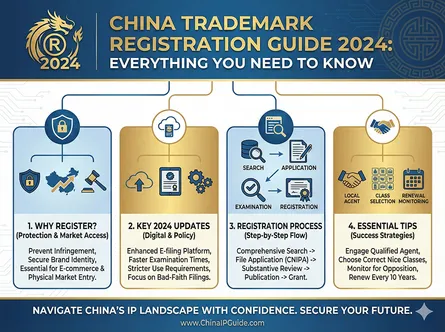
China Trademark Registration Guide 2024: Everything You Need to Know

Understanding China's trademark system is crucial for any international brand entering the Chinese market. This comprehensive guide covers everything you need to know about trademark registration in China in 2024. Why Trademark Protection Matters in China China operates on a "first-to-file" system, meaning whoever files first owns the trademark rights—regardless of who used it first internationally. This has led to numerous cases of trademark squatting, where local entities register famous foreign brands before the actual brand owner does. Notable ExamplesNew Balance lost their Chinese trademark and had to pay $16 million Michael Jordan fought a 7-year legal battle over his Chinese name Tesla's trademark was initially registered by a Chinese businessmanThe Chinese Trademark Registration Process Step 1: Comprehensive Search (2-3 weeks) Before filing, conduct thorough searches across:Exact matches in all 45 Nice Classification classes Phonetic similarities in Chinese Visual similarities in logos Translation variationsPro Tip: Chinese consumers often create their own translations of foreign brand names. Search for these "folk translations" to avoid conflicts. Step 2: Chinese Name Selection Choosing the right Chinese name is critical. Consider:Phonetic similarity to your original name Positive meaning in Chinese Cultural appropriateness Memorability for Chinese consumers"The China IP Gateway team helped us build a full defensive trademark strategy. The dashboard showed real-time updates." - Kenji Tanaka, Luminex JapanStep 3: Multi-Class Filing Strategy Most brands need protection in multiple classes:Core classes: Your actual products/services Defensive classes: Adjacent categories where infringement is likely E-commerce classes: Class 35 for online retail is essentialStep 4: Application Filing (1-2 weeks) Required documents:Application forms for each class Clear trademark specimens Applicant identification documents Power of AttorneyStep 5: Examination (9-12 months) CNIPA (China National Intellectual Property Administration) reviews your application for:Absolute grounds (descriptiveness, prohibited marks) Relative grounds (conflicts with existing marks)Step 6: Publication & Registration (3 months) If approved, your trademark is published for opposition. If no opposition is filed within 3 months, you receive your registration certificate. Total Timeline: 12-15 months Pricing Structure Basic Registration: USD 600-900 per classIncludes search, filing, and official fees Monitoring during examination Certificate deliveryComprehensive Protection Package: Custom pricingMulti-class registration Defensive filing strategy Chinese name consultation Ongoing monitoringCommon Challenges & Solutions Challenge 1: Similar Existing Marks Solution: File in specific subclasses or modify your mark slightly while maintaining brand identity. Challenge 2: Descriptive Terms Solution: Add distinctive elements or create a coined term that's unique to China. Challenge 3: Translation Issues Solution: Work with native Chinese trademark experts who understand both linguistic and cultural nuances. Best Practices for International BrandsFile Early: Before entering the market or making announcements File Broadly: Cover all relevant classes from the start Monitor Actively: Set up trademark watching services Enforce Consistently: Take action against infringers quickly Use Professional Help: The cost of mistakes far exceeds professional feesPost-Registration MaintenanceRenewal: Every 10 years Use Requirements: Use within 3 years to avoid cancellation Record keeping: Maintain evidence of use Customs recordation: Register with Chinese customs for border enforcementConclusion Trademark protection in China requires proactive planning and expert guidance. With the right strategy, you can secure strong protection for your brand in the world's largest consumer market. Ready to protect your brand in China? Contact our trademark experts for a free consultation.